
Updated: October 16, 2026
Disclosure: GearSift is reader-supported. We research every pick, and no brand pays to be included. This article contains no affiliate links. How we make money
On paper, the Samsung T7 and T7 Shield are the same fast drive: USB 3.2 Gen 2, up to 1,050 MB/s read and 1,000 MB/s write, by Samsung’s figures. The difference is the shell. The Shield adds an IP65 water and dust rating and a higher drop rating, and it’s bigger and heavier for it.
Scope: two Samsung portable SSDs, 1TB versions, linked to Samsung’s own US store.
Which to pick
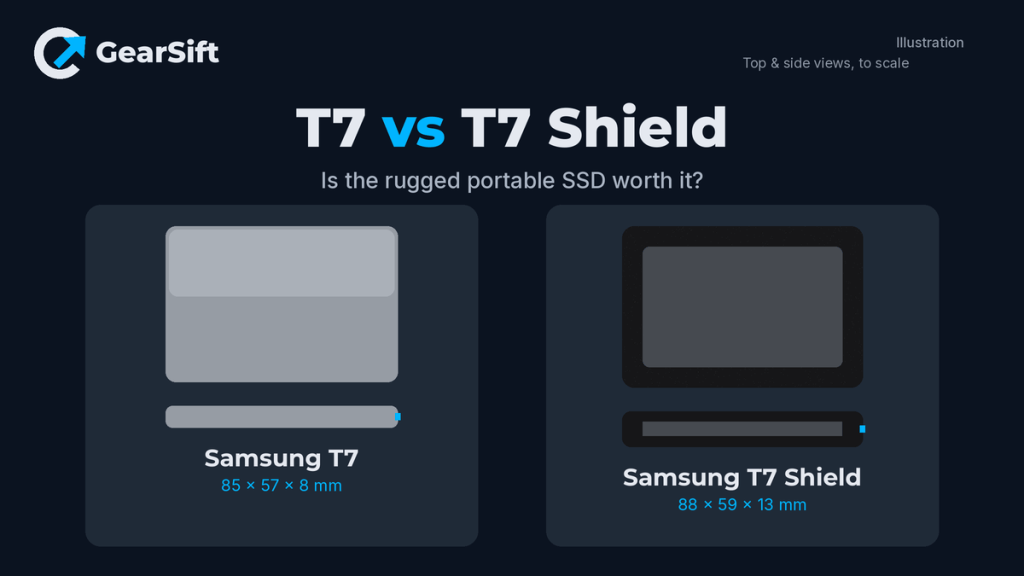
- Pick the Samsung T7 if the drive lives in a laptop bag or on a desk. Our pick because: Samsung lists the same speeds as the Shield in a smaller, lighter body: 85 x 57 x 8 mm [1], and 2.0 oz on the product page [3] or 72 g in the datasheet [1], and it’s the lower price tier of the two.
- Pick the Samsung T7 Shield if it travels, gets wet or gets dropped. Our pick because: Samsung’s datasheet lists an IP65 rating and drop resistance up to 3 m [2], neither of which the T7’s datasheet lists (it lists drops up to 2 m and no IP rating) [1].
How we chose: research-based. We used Samsung’s US store pages and Samsung’s datasheets for both drives (cited below). This comparison covers two Samsung models only. We have not physically tested these drives. All performance and durability figures are Samsung’s.
Side-by-side
| Samsung T7 (1TB) | Samsung T7 Shield (1TB) | |
|---|---|---|
| Interface | USB 3.2 Gen 2 (10 Gbps) [1] | USB 3.2 Gen2 (10Gbps) [2] |
| Sequential read / write (Samsung) | Up to 1,050 / 1,000 MB/s [1] | Up to 1,050 / 1,000 MB/s [2] |
| Capacities | 1TB, 2TB, 4TB [1] | 1TB, 2TB, 4TB [2] |
| Water / dust rating | Not listed on product page/datasheet [1][3] | IP65 [2][4] |
| Drop rating (Samsung) | Up to 2 m [1] | Up to 3 m [2] |
| Dimensions | 85 x 57 x 8 mm [1] | 88 x 59 x 13 mm [2] |
| Weight | Conflicting: 2.0 oz (product page) [3] / 72 g (datasheet) [1] | 98 g [2] |
| Encryption | AES 256-bit hardware encryption [1] | AES 256-bit hardware encryption [2] |
| Cables in box | USB Type-C to A and Type-C to C [1] | USB Type-C to C and Type-C to A [2] |
| Warranty | Three (3) Year Limited Warranty [1] | Three (3) Year Limited Warranty [2] |
| Price tier | Mid | Premium |
Price tiers are relative to the products in this article. Each tier is based on the maker’s own US store listing, checked October 16, 2026 (ET). We don’t list street or retail prices because they change. “Not assigned” means we couldn’t find a price on the maker’s own US site. Check the current price before you buy.
Speed: no difference on paper
Samsung gives both drives the same interface and the same “Up to 1,050 MB/sec” read and “Up to 1,000 MB/sec” write [1][2]. Both datasheets add that those maximums are “measured based on Samsung’s internal testing standards with the enclosed cable”, and that results vary with your computer and cable [1][2]. If speed is your only concern, the two drives are a wash by Samsung’s numbers. (Our reading of Samsung’s figures, not a test result.)
What the Shield adds
Water and dust. Samsung’s Shield store page lists it as “IP65 Rated” [4], and the datasheet explains the test: the IPX5 part means fresh water “projected from a nozzle” for 3 minutes, and the IP6X part means 8 hours in a dust chamber [2]. The T7’s store page lists “Shock Resistant” [3] but no water or dust rating, and neither does its datasheet [1].
Drops. The Shield’s store page says “Rugged durability enduring up to 9.8 ft drop” [4]; its datasheet lists “Up to 3m” [2]. The T7’s datasheet lists “Up to 2 m” [1]. Both ratings come from a free fall onto a metal plate under controlled conditions [1][2].
The trade-off. The Shield is 13 mm thick and 98 g, against 8 mm for the T7 [1][2]. The T7 weighs 2.0 oz per its product page [3] or 72 g per its datasheet [1], so the Shield is the heavier drive either way, with a little more bulk in a pocket.
What the ratings don’t cover
Read the footnotes before you treat either drive as indestructible. Both datasheets say “Damage caused by drop is not covered under warranty” [1][2], and the Shield’s adds “Damage caused by liquid and dust are not covered under warranty” [2]. Samsung also notes that water and dust resistance “may vary depending on the actual environmental conditions” [2]. Our take: the Shield lowers the odds of a bad day, but it’s no substitute for a second copy of your files.
Buy
- Buy the Samsung T7 1TB (Gray) at the Samsung store
- Buy the Samsung T7 Shield 1TB (Black) at the Samsung store
Comparing more brands? See our full guide: Best portable SSDs
Related: NAS vs DAS vs external hard drive · Best M.2 NVMe SSD enclosures
Real gear for a better everyday.
Sources (all checked October 16, 2026, ET)
- Samsung Semiconductor, Portable SSD T7 Data Sheet Rev 2.0 (specs): https://download.semiconductor.samsung.com/resources/data-sheet/Samsung_Portable_SSD_T7_Datasheet_Rev.2.0.pdf
- Samsung Semiconductor, Portable SSD T7 Shield Data Sheet Rev 2.0 (specs): https://download.semiconductor.samsung.com/resources/data-sheet/Samsung_Portable_SSD_T7_Shield_Datasheet_Rev.2.0.pdf
- Samsung US store, Portable SSD T7 1TB (Gray), MU-PC1T0T/AM: https://www.samsung.com/us/memory-storage/portable-ssd/portable-ssd-t7-usb-3-2-1tb-gray-sku-mu-pc1t0t-am/
- Samsung US store, Portable SSD T7 Shield 1TB (Black), MU-PE1T0S/AM: https://www.samsung.com/us/memory-storage/portable-ssd/portable-ssd-t7-shield-usb-3-2-1tb-black-sku-mu-pe1t0s-am/


Leave a Reply