
Updated: October 17, 2026
Disclosure: GearSift is reader-supported. We research every pick, and no brand pays to be included. This article contains no affiliate links. How we make money
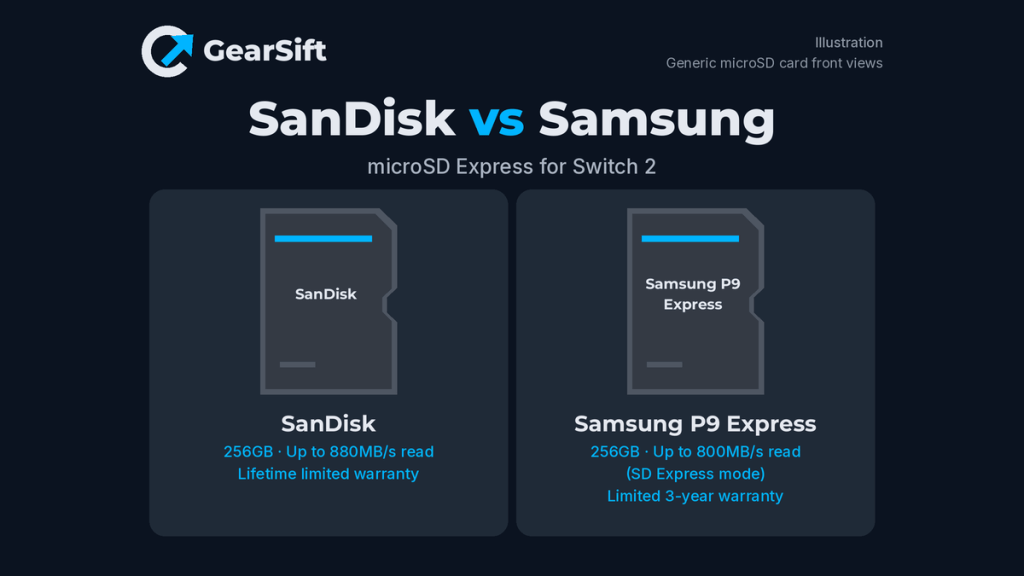
Switch 2 game storage comes down to one card format. Nintendo puts it plainly: “Nintendo Switch 2 is only compatible with microSD Express cards.” [1] SanDisk and Samsung each sell one aimed at Switch 2 owners: the SANDISK microSD Express Card for Nintendo Switch 2 and the Samsung P9 Express [3][6]. Both are microSD Express cards [3][5], so both meet Nintendo’s rule. The differences are in what each maker rates, lists and promises.
Scope: two microSD Express cards, 256GB versions, linked to each maker’s own US store.
Which to pick
- Pick the SanDisk if you want the card that’s licensed for Switch 2 and the longest warranty. Our pick because: SanDisk calls it “officially licensed” for Nintendo Switch 2 [3], rates the 256GB card at up to 880MB/s read and 650MB/s write [3][4], and gives it a lifetime limited warranty [3][4]. It’s also the only one of the two listed in 1TB [3][4].
- Pick the Samsung P9 Express if the card will also spend time in older microSD devices. Our pick because: Samsung lists a read speed for both modes, “SD Express 800 MB/s, UHS-I 90 MB/s” [5], plus speed classes and random-access figures that SanDisk doesn’t list [5][6]. Its warranty is shorter: limited 3-year [5][6].
How we chose: research-based. We used Nintendo’s support and tech-specs pages, SanDisk’s and Samsung’s US store pages, and each maker’s datasheet (cited below). This comparison covers two cards only. We have not physically tested these cards. All speed, durability and warranty figures are the makers’ own, and real-world speed depends on the device you use.
Side-by-side (256GB)
| SANDISK microSD Express Card for Nintendo Switch 2, 256GB (SDSQXFN-256G-GR6ZZ) | Samsung P9 Express, 256GB (MB-MK256T/AM) | |
|---|---|---|
| Switch 2 | Officially licensed; compatibility listed as Nintendo Switch 2 [3][4] | Works with Nintendo Switch 2 (brochure) [6] |
| Interface | PCIe 3.1 NVMe and microSD UHS-I (datasheet) [4] | PCIe Gen3.0x1, NVMe 1.3, SD 7.1, UHS-I [5][6] |
| Sequential read (up to) | 880MB/s [3][4] | 800MB/s in SD Express mode; 90MB/s in UHS-I mode [5][6] |
| Sequential write (up to) | 650MB/s; 210MB/s minimum sustained write [3][4] | Not listed on product page/datasheet [5][6] |
| Random read / write (4KB, QD32) | Not listed on product page/datasheet | 65K / 52K IOPS (SD Express); 2K / 2K IOPS (UHS-I) [5][6] |
| Speed class | Not listed on product page/datasheet | U3, V30, A1 [5][6] |
| Heat management | ThermAdapt technology [3][4] | Dynamic Thermal Guard (DTG) [5][6] |
| Operating temperature | -13°F to 185°F (-25°C to 85°C) [4] | 0–113°F [5] (0°C to 45°C [6]) |
| Durability claims | Eight extreme conditions [3][4] | 6-proof: water, temperature, X-ray, magnet, drop, wear-out [6] |
| Capacities (maker store) | 256GB, 512GB, 1TB [3][4] | 256GB, 512GB [5][6] |
| Warranty | Lifetime limited (30-year where lifetime isn’t recognised) [3][4] | Limited 3-year [5][6] |
| Price tier | Mid | Mid |
Price tiers are relative to the products in this article. Each tier is based on the maker’s own US store listing, checked October 17, 2026 (ET). We don’t list street or retail prices because they change. “Not assigned” means we couldn’t find a price on the maker’s own US site. Check the current price before you buy.
What Switch 2 actually requires
Nintendo’s support page and its Switch 2 tech specs say the same thing: the console’s card slot takes microSD Express cards only, up to 2TB [1][2]. A regular microSD card that you used in the original Switch won’t let you save or load digital games or save data on Switch 2, though you can still copy screenshots and videos from it [1][2]. Nintendo also notes that a system update over the internet is needed the first time you use a microSD Express card [1].
Going the other way, a microSD Express card does work in the original Switch, but Nintendo says it reads and writes there at the same speed as a regular microSD card [1]. So either card here is a Switch 2 purchase first.
Speed: what each maker rates
SanDisk rates the 256GB card at up to 880MB/s read and up to 650MB/s write [3][4]. Its footnote adds a floor: “210 MB/s minimum sustained write speed” [3][4]. SanDisk says those numbers need a compatible device and are “Based on internal testing” [3][4].
Samsung rates the P9 Express at up to 800MB/s sequential read in SD Express mode [5][6]. Its US page and datasheet don’t list a sequential write speed for the card [5][6]. What they do list are random-access figures: 65K IOPS read and 52K IOPS write (4KB, QD32) in SD Express mode [5][6]. Samsung also says the read speed is up to four times its own UHS-I microSD cards, based on its internal testing of the 512GB P9 Express on a PCIe test board [6].
On paper, SanDisk lists 80MB/s more peak read and gives a write figure that Samsung’s US page and brochure don’t list [5][6]. Our take: that’s a spec-sheet gap, not a measured one. Both makers test their own cards their own way [3][6], and neither figure tells you how a given game will load on Switch 2. We’d treat read speed as roughly a tie and decide on the other rows.
Outside the Switch 2: UHS-I mode
This is where the two makers’ pages differ most. Samsung lists UHS-I in the P9 Express interface and gives it a UHS-I rating of 90MB/s read, plus UHS-I random figures of 2K IOPS [5][6]. If the card might end up in a phone, camera or older handheld with a standard microSD slot, Samsung tells you what to expect there.
SanDisk’s datasheet lists the interface as PCIe 3.1 NVMe and microSD UHS-I [4], but it gives no UHS-I speed, and both its datasheet and its store page list device compatibility as Nintendo Switch 2 only [3][4]. So the SanDisk card has a UHS-I interface on paper, without a published speed or device list for that mode. Our take: if a second device matters to you, Samsung’s published UHS-I numbers make it the easier card to plan around.
Heat, durability and warranty
Both makers address heat. SanDisk credits its ThermAdapt technology with managing card heat [3][4], and Samsung says its Dynamic Thermal Guard (DTG) keeps the card at optimal temperatures [5][6]. Neither page gives a test method we could compare, so we don’t rank them on this.
On listed operating temperature, SanDisk’s datasheet gives a wider range, -25°C to 85°C [4], against 0°C to 45°C for the P9 Express [6]. SanDisk says the card withstands eight extreme conditions, with details on its proof page [3][4]; Samsung lists six kinds of protection, water, temperature, X-ray, magnet, drop and wear-out, each with its own test condition [6].
The clearest difference is the warranty. SanDisk gives a lifetime limited warranty, or 30 years in Germany, Canada and regions that don’t recognise lifetime warranties [3][4]. Samsung gives a limited 3-year warranty [5][6]. Our take: a warranty covers the card, not your save files, so keep a backup of anything you’d hate to lose.
Capacity: how much space you get
Both cards come in 256GB and 512GB on their makers’ US stores [3][5]. Only SanDisk lists a 1TB version [3][4], and SanDisk rates its 1TB card higher for writes, up to 800MB/s [3][4]. SanDisk’s own estimate is about 9 Switch 2 games on the 256GB card, based on an average game size of 25GB [3]. That’s SanDisk’s approximation, not ours, and game sizes vary.
Nintendo supports cards up to 2TB [1][2], so neither maker’s largest card is near the console’s limit. Our take: if you buy big digital games often, look at 512GB, the largest size both stores list [3][5].
The bottom line
Our take: for most Switch 2 owners buying a first card, either one meets Nintendo’s requirement [1]. The SanDisk wins on licensing, warranty length and the 1TB option [3][4]; Samsung’s pages we checked don’t describe the P9 Express as Nintendo-licensed [5][6]. The Samsung wins on published detail, with UHS-I speeds, speed classes and random-access figures you can check [5][6]. Both sit in the same price tier at 256GB.
Buy
- Buy the SANDISK microSD Express Card for Nintendo Switch 2 (256GB) at the SanDisk store
- Buy the Samsung P9 Express (256GB) at the Samsung US store
Want the full picture? See our guide: Best microSD Express cards for Nintendo Switch 2. Capturing Switch 2 gameplay? See Best capture cards for Switch 2 and PS5 and Elgato 4K S vs 4K X. How we pick and source products: How we research.
Nintendo Switch 2 is a trademark of Nintendo. GearSift isn’t affiliated with or endorsed by Nintendo, SanDisk or Samsung.
Real gear for a better everyday.
Sources (all checked October 17, 2026, ET)
- Nintendo Support (US), “microSD Card and microSD Express Card Compatibility with Nintendo Switch 2 and Nintendo Switch”: https://en-americas-support.nintendo.com/app/answers/detail/a_id/68425/
- Nintendo, Nintendo Switch 2 tech specs (specs): https://www.nintendo.com/us/gaming-systems/switch-2/tech-specs/
- SanDisk US store, SANDISK microSD Express Card for Nintendo Switch 2, 256GB, SDSQXFN-256G-GR6ZZ (product page, specifications and disclosures): https://www.sandisk.com/products/memory-cards/microsd-cards/sandisk-microsd-express-card-for-nintendo-switch-2?sku=SDSQXFN-256G-GR6ZZ
- SanDisk, SANDISK microSD Express Card for Nintendo Switch 2 data sheet (specs; PDF): https://documents.sandisk.com/content/dam/asset-library/en_us/assets/public/sandisk/product/memory-cards/microsd-express-card-for-nintendo-switch-2/data-sheet-microsd-express-card-for-nintendo-switch-2.pdf
- Samsung US store, 256GB microSD Express Card P9 Express, MB-MK256T/AM (product page and specs): https://www.samsung.com/us/memory-storage/memory-card/p9-256gb-microsd-express-card-sku-mb-mk256t-am/
- Samsung Semiconductor, P9 Express microSD Express card brochure (specs; PDF): https://download.semiconductor.samsung.com/resources/brochure/microSD_Express_Card_P9_Express_Brochure.pdf


Leave a Reply